

Submission on the National Pollutant Inventory NEPM Variation
15 September 2006
The Australian Network of Environmental Defender's Offices (ANEDO) consists of nine independently constituted and managed community environmental law centres located in each State and Territory of Australia. Each EDO is dedicated to protecting the environment in the public interest. EDOs provide legal representation and advice, take an active role in environmental law reform and policy formulation, and offer a significant education program designed to facilitate public participation in environmental decision making.
|
EDO ACT (tel. 02 6247 9420)
edoact@edo.org.au EDO NSW (tel. 02 9262 6989) edonsw@edo.org.au EDO NQ (tel. 07 4031 4766) EDO NT (tel. 08 8982 1182) EDO QLD (tel. 07 3210 0275) EDO SA (tel. 08 8410 3833) EDO TAS (tel. 03 6223 2770) EDOVIC (tel. 03 9328 4811) EDO WA (tel. 08 9221 3030)
|
This submission is on behalf of the Australian Network of Environmental Defender's Offices (ANEDO).
For further information on this submission, please contact Rachel Walmsley , Policy Director at EDO (NSW) on 02 9262 6989 or rachel.walmsley@edo.org.au.
Submitted to:
Ms Monina Gilbey
Project Officer
NEPC Service Corporation
Level 5, 81 Flinders Street
Adelaide SA 5000
Telephone (08) 8419 1200
Facsimile (08) 8224 0912
Email mgilbey@ephc.gov.au

CONTENTS
1. Introduction
2. Name change
3. Inclusion of transfers
4. Inclusion of greenhouse gas emissions
5. Substance and threshold changes
5.1 Substance List
5.2 Thresholds
5.3 Lead and lead compounds
5.4 Other toxicants
5.5 Agricultural and Veterinary Chemicals5.5.1 Fertilisers
5.5.2 Pesticides and Herbicides
6. Reporting of aquaculture activities
7. Changes to publication requirements
7.1 Reporting times
8. Other issues
8.1 Non-anthropogenic sources
8.2 NPI Reporting Tools
8.3 Web-based reporting system
8.4 Diffuse source emissions reporting
8.5 Public Participation
8.6 Data quality and quality assurance
8.7 Public surveys
9. Conclusion: Do these amendments further the goals of NEPM?
1.
Introduction
In July 2005, the National Environment Protection Council (NEPC) commenced the statutory process to make a variation to the National Pollutant Inventory (NPI) National Environment Protection Measure (NEPM) (‘ NPI NEPM'). In June 2006, NEPC agreed to release a draft NEPM variation, impact statement and other supporting documents for public consultation. The Australian Network of Environmental Defenders Offices Inc (‘ ANEDO ') welcomes the opportunity to provide comment on the proposed changes. This submission includes input from our in-house scientific advisory service.
Major changes to the NPI proposed in the documentation include:
- name change;
- inclusion of transfers;
- inclusion of greenhouse gas emissions;
- substance and threshold changes;
- removing the exemption for aquaculture reporting; and
- changes to publication requirements.
The variation also includes other matters identified in the 2005 Environment Link Report: Review of the National Pollutant Inventory (‘ NPI Review Report').1
This submission addresses each of the major proposed changes in turn, and addresses additional issues raised by recommendations of the NPI Review Report.
2. Name change
We understand that a name change is proposed, to the ‘National Emissions Inventory' rather than the ‘National Pollutant Inventory.' ANEDO acknowledges the advantageous promotional opportunities around a re-branding of the scheme as we support greater public awareness and use of the service. However, the proposed name change may be potentially misleading for the public if greenhouse gas emissions are not included on the inventory. This issue is discussed further below.
3. Inclusion of transfers
ANEDO supports the inclusion of transfers in the NPI NEPM. The reporting of transfers is considered important for the NPI NEPM to meet its objectives of providing the community with information on the fate of chemicals produced or used by industry, and encouraging better corporate environmental behaviour, including waste minimisation, cleaner production and an expansion in the re-use and recycling of materials.
The inclusion of transfers will enable the NPI to achieve the status of a Pollutant Release and Transfer Register (PRTR) as recommended by the Organisation for Economic Cooperation and Development (OECD). A review by the OECD in 2001 indicated that the majority of PRTRs around the world require reporting of transfers. Australia is one of the few countries which have not yet included transfers reporting.2
ANEDO is generally satisfied with the proposed scope of transfers reporting. ANEDO agrees that transfers should be reported separately to emissions; that the transfer of products should be excluded; and that only on site transfers where no future movement of materials will occur should be reported. ANEDO also agrees that the substance list and thresholds for reporting transfers should be consistent with those for reporting emissions, and that waste rock and associated overburden (assuming it has not been chemically modified) should be excluded from transfers reporting.
ANEDO supports the proposed reporting of the type of transfer (for example, containment, destruction, reuse, recycling) and the type of containment or destruction. Whilst it is understood that reporting on the nature and management of the receiving facility is a good way to encourage best practice, ANEDO is of the opinion that this would need to be closely monitored and reviewed to ensure good quality data is reported to the public.
4. Inclusion of greenhouse gas emissions
According to the EPHC website:
At its meeting on 14 July 2006, in relation to energy and greenhouse gas emissions reporting, the Council of Australian Governments (COAG) agreed that a single streamlined system that imposes the least cost and red tape burden is the preferable course of action. To this end:
- COAG agreed that Senior Officials report back to COAG in December 2006 with a proposal for streamlining emissions and energy reporting in line with the above objectives. The report should be based on the preparation of national purpose-built legislation to provide for cost-effective mandatory reporting and disclosure at the company level at the earliest practicable date. The report will also need to include advice on timing, thresholds and governance arrangements;
- COAG also agreed that the National Pollutant Inventory (NPI) would not be used as a vehicle for reporting greenhouse gas emissions and that no further work be undertaken by the Environment Protection and Heritage Council on incorporating greenhouse gas emission reporting in the NPI pending finalisation of the above report; and
- COAG further agreed that every effort should be made to reach agreement on a national purpose-built legislation by December 2006. States and Territories reserved the right to use the NPI if the Commonwealth, States and Territories failed to reach agreement on national purpose-built legislation at COAG's next meeting.
ANEDO supports a consistent reporting system for greenhouse gas emissions, but submits that the push to “streamline” regulatory requirements must not be at the expense of fully accountable, accurate and transparent reporting.
ANEDO's strong preference is for a purpose-build national mandatory greenhouse gas and energy reporting scheme that requires full reporting at the company level. Reports should be publicly available and audited. The EPHC and COAG should progress this as a priority.
However, ANEDO is concerned at the delay in commencing greenhouse gas emissions reporting and therefore supports the NPI being used if purpose-built legislation is not commenced in each jurisdiction by December 2006. As noted in Environmental Manager 3 based on a pilot in Victoria for reporting greenhouse gas emissions, reporting could be done using the NPI reporting system or OSCAR (the Commonwealth Government reporting tool). The Victorian EPA described the NPI option as the “lowest red tape option” and “low effort to report.” Furthermore, using NPI for reporting for greenhouse gas emissions could commence as early as 2007.4
Notwithstanding the benefits of low cost, if the NPI was to be used for reporting greenhouse gas emissions, it must be made clear that companies should be held to account for their total emissions including: emissions of subsidiary fleet cars, head office emissions, and travel. Reporting should be broken down into types of emissions and preferably into facilities where a facility's emissions are significant. It is preferable that a parent company report and be responsible for the emissions of its subsidiaries; and identify each subsidiary's emissions in relation to the total emissions. The NPI may need to amended to facilitate this detail if used as an interim measure for greenhouse gas emissions reporting.
5. Substance and threshold changes
5.1 Substance List
ANEDO notes that the terms of reference for the Technical Advisory Panel (TAP) review of the NPI NEPM were derived from the conclusions of the NPI Review Report. ANEDO has reviewed the NPI Review Report and considers that the approach used to review the NPI substance list and substance thresholds was inadequate. The NPI Review Report does not clearly identify the basis on which substances were nominated for inclusion or deletion from the NPI substance list. It appears this process was primarily driven by a range of interest groups, including industry, government and environment, who responded to a questionnaire. We believe the basis for the review of the NPI substance list and substance thresholds should have been driven primarily by scientific expertise and not the opinions of interest groups. A detailed review of the substance list and substance thresholds has not been undertaken, with international experience and the outcomes of one previous review5 cited only briefly. We believe the approach taken has constrained the ability of the TAP to undertake the necessary detailed review of the NPI substance list and substance thresholds.
The TAP did not undertake a comprehensive review of the NPI substance list for the 2006 variation, owing to the large amount of work required to do this and the tight deadline for the TAP Report. A limited number of substances were reviewed based on the recommendations of the NPI Review Report, which as identified above, were derived from information gathered in consultation with stakeholders from a range of interest groups.
The inadequacy of the current review in terms of review of the substance list is acknowledged within the TAP Report.6 The TAP has recommended that any future revision of the NPI involve consideration of re-creating and updating the full NPI candidate list from chemicals that meet European Union (EU) criteria for classification as environmentally hazardous. ANEDO supports such a detailed revision of the substance list. The original NPI list of 90 substances for emissions reporting was created in 2000 by selecting from 477 chemicals in the EU classification system. We note that the number of chemicals in the EU classification system has now increased to 1702 due to the use of combined risk phrases. A detailed revision of the substance list should include consideration of these recent changes.
Australia 's NPI currently requires reporting on fewer substances than most other PRTRs internationally. Where the NPI requires reporting on 90 substances, the United States' (US) Toxic Release Inventory (TRI) requires reporting on 643 substances, the United Kingdom's (UK) Pollutant Inventory (PI) on 183 substances and Japan's PRTR on 354 substances. The number of listed chemicals for PRTRs worldwide is presented in the table below.
Table 1: Number of Chemicals Listed on PRTRs Internationally 7
Country |
Number of Listed Chemicals |
Australia |
90 |
United States |
643 |
United Kingdom |
183 |
Japan |
354 |
Canada |
245 |
Netherlands |
180 |
Norway |
250 |
The OECD acknowledges that the number of chemicals and the specific species covered varies significantly from country to country. The OECD attributes this to differences in national priorities (for example, what chemicals are already regulated and what chemicals are of public concern), the economic activities in a country and the maturity of the PRTR system (PRTR reporting lists are usually extended over time).
ANEDO supports regular review of the substance list. For example, i n the UK , a review of the substances on the PI is carried out every three years to ensure that relevant and appropriate information is being collected. Australia 's NPI substance list has not been reviewed in detail for six years. Considering that further review of the NPI is not proposed until 2008, and Australia has substantially fewer listed substances than other countries, ANEDO is of the opinion that it would have been warranted to undertake a more detailed review of the substance list as part of the current review.
Review of the substance list could draw on a range of resources, including the National Industrial Chemicals Notification and Assessment Scheme (NICNAS) database. Through its company registration and data collection systems, NICNAS collects manufacturing and import volume statistics. This data could be used in review of the NPI substance list to understand what chemicals are currently in use in Australia .
The limited review undertaken by the TAP recommended a number of changes to the NPI substance list. Most of these changes have been reflected in the draft variation to the NPI NEPM. ANEDO generally supports the proposed changes to the NPI NEPM substance list and notes the following:
- The TAP recommended that polychlorinated biphenyls (PCBs) be added to the substance list. This change has not been reflected in the table of amendments in the draft variation, although PCBs have been included in Table 1. ANEDO would like to confirm that PCBs will be included on the substance list. Although import of PCBs into Australia has ceased and use is declining, PCBs are persistent and bioaccumulative and pose a significant threat to the environment. PCBs are an important hazardous waste due to the large volumes historically imported to Australia . The inclusion of transfers in the NPI has therefore meant that reporting of PCBs is highly relevant.
- The TAP recommended that 1,3-dichloropropene is not included on the substance list on the basis that its use is limited. Of concern to ANEDO is that the Australian Pesticides and Veterinary Medicines Authority (APVMA) lists 1,3-dichlorpropene as registered for use in Australia and Dow Chemicals lists 1,3-dichlorpropene on its Record of Approved Active Constituents for Agricultural Products . The APVMA, the notification and assessment body for this compound, declined to provide information to the TAP on the manufacture or import of this chemical due to ‘commercial-in-confidence' issues. In the absence of definitive evidence on the manufacture or import of this 1,3-dichlorpropene, ANEDO considers that the precautionary principle should apply and this compound should be included on the substance list.
5.2 Thresholds
The current review of the NPI NEPM did not involve a comprehensive assessment of the NPI substance thresholds. Only the reporting thresholds for particulate matter and mercury were reconsidered based on the recommendations of the NPI Review Report.
Countries use different kinds of reporting thresholds. Thresholds can be based on the number of employees at a reporting facility, the amount of chemicals produced, processed or otherwise used or the type of activity being carried out. The quantitative value of thresholds varies between countries due to these differences in reporting requirements.
The thresholds used for selected compounds in Australia , the US , the UK and Canada are presented in Table 2. Australia determines thresholds using different criteria to those used in other countries for some compounds (including PAHs, dioxins and furans) making comparison difficult. For example, the threshold used for dioxins in Australia is based on the amount of waste or fuel burnt, the megawatt hours of electricity used, or the megawatt rating of the facility; whereas the threshold used in the US and UK is based on the amount manufactured, processed or otherwise used. We believe that the threshold criteria used in Australia should be investigated to ensure that it adequately captures all facilities emitting compounds such as dioxins. Dioxins are highly toxic and emissions of even very low concentrations to the environment can have detrimental impacts.
Also of note is that Australia has substantially higher reporting thresholds than the US and Canada for lead, and the UK and Canada for a range of other metals including arsenic, cadmium and chromium (VI).
Table 2: Substance Reporting Thresholds for PRTRs Internationally
Metals |
Substance Thresholds (kg) |
|||
Australia 8 |
United States 9 |
United Kingdom 10 |
Canada 11 |
|
Arsenic |
10,000^ |
4,536 (used) 11,340 (manufactured) |
1 |
50 |
Cadmium |
10,000^ |
1 |
5 |
|
Chromium (VI) |
10,000^ |
10 |
50 |
|
Lead |
10,000^ |
45 |
100 |
50 |
Mercury |
5 |
4.5 |
0.1 (water), 1 (air) |
5 |
PAHs |
*^ |
45 |
50 |
50 |
Dioxins & Furans |
^ |
0.0001 |
0.00001 |
# |
Hexachlorobenzene |
Not Listed |
4.5 |
10 |
# |
^ burning of 2,000 tonnes of fuel or waste in one year, consumption of 60,000 megawatt hours of electrical energy in one year, or if the facility is rated at 20 megawatts (not for lighting or motive purposes).
* Burning of 400 tonnes of fuel or waste in one year, or 1 tonne of fuel or waste in any hour in the year.
# report for all activities including incineration, metal smelting, iron and steel manufacturing, cement manufacturing, chlorinated solvent production, power generation, pulp and paper manufacturing, wood preservation, etc.
The proper levels for thresholds should be carefully considered.12 If thresholds are set too high, releases of chemicals of environmental significance may not be reported. Relatively small releases of some chemicals can pose human health and environmental threats. Other chemicals are of particular concern not only because they are toxic, but also because they remain in the environment for long periods of time, are not readily destroyed, and build up or accumulate in body tissue (for example: mercury, organochlorine pesticides and PAHs).
The US and Canada have recently lowered their reporting thresholds for chemicals that are considered to be persistent and bioaccumulative. Considering that further review of the NPI is not proposed until 2008, and Australia has substantially higher thresholds for some compounds than other countries, ANEDO is of the opinion that it would have been warranted to undertake a more detailed review of the substance thresholds as part of the current review.
The review undertaken by the TAP recommended a number of changes to the NPI substance thresholds, which have been reflected in the draft variation to the NPI NEPM. ANEDO generally supports these proposed changes.
The reporting threshold for mercury is proposed to be reduced from 10,000 kg to 5 kg in line with reductions made in the US (4.5 kg), the UK (1 kg for emissions to air and 0.1 kg for emissions to water) and Canada (5 kg). Within the table of amendments in the draft variation to the NPI NEPM, a footnote to the change to the mercury threshold states that ‘the Category 1b threshold [of 5 kg] may also be applied to other substances of similar toxicity such as cadmium and lead'. However, Schedule A of the draft variation to the NPI NEPM does not indicate that the thresholds for these compounds will be changed. This should be clarified.
The TAP recognised that reduction of the threshold for mercury to 5 kg might have a flow on effect to other substances, including heavy metals such as cadmium and lead. However there was insufficient time for the TAP to review potential changes to the substance thresholds in detail. ANEDO considers that reporting thresholds for a number of heavy metals should be investigated and reduced for the draft variation to the NPI NEPM and that the thresholds for other compounds should be reviewed in more detail using international experience.
5.3 Lead and lead compounds
ANEDO submits that it is particularly important that investigations are made into substantially lowering the reporting threshold of lead and lead compounds for the draft variation to the NPI NEPM (as has been done for mercury), for a number of reasons:
- Lead may bioaccumulate in humans13 and aquatic organisms.14 The US Environment Protection Authority (US EPA) has classified lead and lead compounds as a persistent bioaccumulative toxic chemical, and this was a key reason for lowering the TRI reporting threshold in 2001.15 In humans, lead may remain in bone for decades. Once in the bone, lead can re-enter the blood and soft tissues, particularly in certain circumstances.16
- Lead may have human health and environmental effects at low exposure levels. Recent evidence in humans indicates that lead can have health effects at very low blood lead levels (< 10 µg/dL) – levels that were previously considered safe.17 Recent studies in the general population indicate that lead may affect the nervous system in children at blood lead levels < 5 µg/dL.18 Lead is unique as a toxicant in that there is now agreement among the US Centers for Disease Control and Prevention, the US Agency for Toxic Substances and Disease Registry, and the US EPA that there is no toxic threshold for lead.19 This means there is no measurable level of lead in the body below which no harm occurs. Lead is toxic to aquatic organisms at very low levels in the environment.20
- Lead may have human health effects in the general population and is not just an issue for occupationally exposed groups. Many recent studies have been undertaken in the general population, particularly on the effects on the nervous system in children and the cardiovascular system in adults.21 While blood lead levels in occupationally exposed groups are generally higher than in the general population, levels in the general population in developed countries remain significant (in the range 1 – 10 µg/dL).22
- Lead has recently been upgraded from the status of a possible to a probable human carcinogen by the International Agency for Research on Cancer (IARC), based on sufficient evidence for carcinogenic effects in humans.23
5.4 Other toxicants
We also believe that investigations should be made into lowering the reporting threshold of other toxicants for the draft variation to the NPI NEPM.
- The TAP indicated that the Category 1b threshold [of 5 kg] may also be applied to cadmium. We believe that investigations should be made into substantially lowering the reporting threshold of cadmium. Cadmium may bioaccumulate in humans24 and aquatic organisms.25 In humans it accumulates especially in the kidney and liver and may remain there for many years. There is substantial evidence that cadmium causes kidney disease, and it may also cause other effects including lung damage and effects on bone strength.26 IARC has determined that cadmium is carcinogenic to humans.27 Recent evidence in humans suggests cadmium can have health effects at levels that were previously considered safe.28 Cadmium is toxic to aquatic organisms at very low levels in the environment.29
- We also believe that investigations should be made into lowering the reporting threshold of other toxicants that are persistent and bioaccumulate and have human health and environmental effects at low exposure levels. We note that the reporting thresholds for arsenic and chromium (IV) both in the UK and Canada are set at substantially lower levels than proposed for the draft variation to the NPI NEPM (see Table 2). Both these substances may bioaccumulate in aquatic organisms to some extent and are toxic at low exposure levels.30
5.5 Agricultural and Veterinary Chemicals
Agricultural and veterinary chemicals (Agvets) include fertilisers, pesticides and herbicides.
5.5.1 Fertilisers
Fertilisers, comprising nutrients nitrogen and phosphorous, are applied to agricultural land in large quantities. Although not a significant risk to human health, fertilizers have the potential to run off into waterways and impact on aquatic ecosystems. This includes the potential for significant impact on sensitive marine ecosystems.31 Nutrient pollution stimulates the growth of cyanobacteria and nuisance plants (including both higher plants and algae) which can dominate and change the dynamics of an aquatic ecosystem. Impacts can include diminishing light availability, displacing endemic species, covering the bed resulting in loss of habitat, impeding fish migration and creating odours.32
ANEDO understands that total nitrogen and total phosphorous are currently included in diffuse source emissions data, but that there are issues with the adequacy of the data, including that estimates are made for only a limited number of catchments. We believe this situation is inadequate, and we do not agree with the conclusion of the NPI Review Report, which suggests that there is no strong imperative to improve the current reporting process.
Across Australia , fertiliser consumption has risen in the last two decades. The broad-scale use of fertilisers has caused significant environmental harm, including algal blooms in many Australian river systems. Currently, nutrient levels are high enough to support algal blooms in all river systems of the Murray-Darling Basin (except the Condamine River ) and some coastal river systems in western Victoria , central and northern NSW, south-east Queensland , northern Queensland and Western Australia.33 We therefore support the suggestion in the NPI Review Report that diffuse source estimates for total nitrogen and total phosphorous be made on a catchment by catchment basis using sales data and modelling. As identified in the Report, there are few commercial in confidence issues with fertiliser products and sales data on a catchment basis could be readily made available.
5.5.2 Pesticides and Herbicides
Pesticides, including organochlorines, organophosphosphates, carbamates and pyrethroids, are used to prevent, destroy, repel or mitigate pests. Herbicides are used to kill weeds and other plants that grow where they are not wanted. Pesticides and herbicides are predominantly associated with large scale food production and pose a potential risk to both human health and the environment. The health effects of pesticides and herbicides will vary depending on the type of compound, the level of exposure and the pathway of exposure. O rganophosphates and carbamates for example, affect the nervous system. Other pesticide compounds may affect the hormone or endocrine system, be carcinogenic, or irritate the skin or eyes. The environmental impacts of pesticides and herbicides will also vary depending on the type of compound, the level of exposure and the pathway of exposure. Pesticides and herbicides are toxic at low concentrations in aquatic ecosystems, are persistent in the environment (i.e, do not degrade easily) and may bioaccumulate in fish and mammal tissues.34
Pesticides and herbicides are currently not included on the NPI substance list. A review of PRTRs indicates that reporting of pesticides and herbicides is undertaken in the US and UK , as shown in the table below.
Table 3: Reporting of Pesticides and Herbicides on PRTRs Internationally
Australia35 |
United States36 |
United Kingdom37 |
Canada38 |
|
Pesticides |
No |
Yes |
Yes |
No |
Herbicides |
No |
Yes |
Yes |
No |
Considering the potential human health and environmental impacts of pesticides and herbicides, and the reporting of these compounds in other countries, ANEDO considers that Agvet chemicals should be added to the NPI substance list.
Farm enterprises in Australia are currently not required to report to the NPI. The NPI aims to target larger enterprises and as such, agricultural land is exempt from reporting. Whilst ANEDO acknowledges that the inclusion of farmers as reporters to the NPI would involve a significant amount of work, the major environmental releases of Agvets are not in the manufacturing of these chemicals, but are due to use by farmers. We therefore consider reporting of the use of pesticides and herbicides by farmers important to understand the release of these compounds to the environment, particularly considering that the release of small amounts of some of these compounds can have substantial environmental impacts. If the NPI does not have the current capacity to accommodate reporting by farm enterprises, ANEDO considers that the reporting of pesticide and herbicide emissions should be included as aggregated emissions data.
ANEDO understands that consideration of the inclusion of Agvets in the NPI has been deferred until such time as the Department of Environment and Heritage can establish a database of chemical use. However the NPI Review Report suggests that it is unknown whether the DEH database will actually include Agvet chemicals. Also, it is noted that considerable problems have been encountered in attempting to compile similar databases due to difficulties accessing the data required. The Australian Pesticides and Veterinary Medicines Association (APVMA) maintains data on the use and sales of Agvets in Australia , however this information is held in confidence and is not publicly available. The NEPC reported that attempts to construct a database of Agvet chemicals by the Australian Academy of Technological Sciences and Engineering, and the Australian Government Department of Agriculture, Fisheries and Forestry (AFFA), were constrained due to difficulties in obtaining data from APVMA.39 Avcare, the National Association for Crop Production and Animal Health, representing manufacturers, formulators and distributors of Agvets, have indicated that they are prepared to share proprietary use information with the government for the purpose of constructing a database, but only with commercial in confidence conditions and public access restrictions. As such, this proposal has not progressed. If the database of chemical use currently being scoped by the DEH does include Agvets, the quality of the data is likely to be poor considering current APVMA and Avcare policies on public availability of data. This is concerning for ANEDO as it affects the communities right to know about pesticides and herbicide emissions to the environment.
6. Reporting of aquaculture activities
ANEDO is fully supportive of the proposal to include aquaculture in the list of reporting industries. The known environmental impacts of aquaculture and the resultant emissions from aquaculture operations do not justify its continuing exclusion as a reporting industry.
The potential impacts of aquaculture are wide-ranging, from aesthetic aspects to direct pollution problems.40 The National Oceans Office has recognised these potential environmental consequences.41 In particular, aquaculture operations lead to the release of nutrients into the water column and the accumulation of waste. This additional input leads to an accumulation of organic matter, which has a marked effect on water quality and benthic biota.42 Furthermore, there are concerns about the use of chemotherapeutants, the outbreak of disease, the impact of marine mammals and genetic disturbance from exotic species.
Table 4 Current environmental concerns arising from marine aquaculture operations (Fernandes et al., 2001)
|
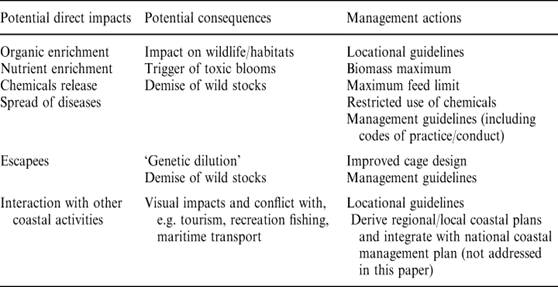
As indicated in the NPI Review Report, a diffuse source manual already exists for aquaculture. Therefore, the practical implications stemming from the inclusion of aquaculture as a reporting industry are straightforward and do not impose an onerous regulatory burden. It is a small price to pay when the environmental consequences of aquaculture operations can be quite significant. Requiring the aquaculture industry to report its emissions enables the public and government to quantify the environmental impact of these emissions. This is in line with the environmental management and public participation goals of the NEPM.
7. Changes to publication requirements
7.1 Reporting times
ANEDO supports recommendation 54 of the NPI Review Report. The EPHC has proposed that a two month extension be given to reporting industries. This involves a pre-release data set becoming public on 31 January of each year, with final release on March 31. The rationale for this is to enable jurisdictions and industry to correct errors before public release. Although the public will receive the final version two months later than usual, there will be likely be measurable benefits in terms of data quality and quality assurance due to data verification during the two month period.
8. Other issues
8.1 Non-anthropogenic sources
ANEDO supports the exclusion of emissions data from non-anthropogenic sources such as wildfires from the main NPI database, consistent with Recommendations 16-18. It is important that the database remains a register of human-induced emissions. The inclusion of natural sources of emissions has the ability to confuse users.
However, ANEDO does support the inclusion of emissions from fire sources that are lit by humans in the diffuse source emissions data. Fuel reduction fires, forest regeneration fires and agricultural burning are all significant contributors to the concentration of particles and Volatile Organic Compounds (VOC's) in the atmosphere, which are precursors of Ozone. Up to date information on these emission sources is therefore crucial if the public policy and comprehensive register goals of the NEPM are to be realised.
We note that non-anthropogenic sources of emissions (such as wildfires) that contribute significantly to particle emissions, can be significant. Information on these emissions is needed if a holistic approach to air pollutants is to be achieved. Hence, ANEDO supports the recommendation that a separate database be established for these sources.
8.2 NPI Reporting Tools
The EPHC has recommended that government and industry work together to critically assess deficiencies in the handbooks and manuals used by industry to estimate their emissions. This has been branded as a high priority initiative. This is done with a view to developing a standard, streamlined format and eliminating the confusion and uncertainty associated with the current handbooks. The NPI Review Report states that discrepancies in Emissions Estimation Techniques in the various manuals have led to certain reporters using estimation methods that are inappropriate to their circumstances so as to reduce workload and reduce reported emissions. This places considerable doubt as to veracity of the reported data. Measures to eliminate these “loopholes” for reporters are welcomed by ANEDO.
ANEDO acknowledges that a complete review of all manuals is a significant commitment. We are nonetheless supportive of recommendations 29-31, and 35-36, as they have the potential to lead to nationwide consistency, more certainty for reporters, and an improvement in data quality.
8.3 Web-based reporting system
These proposed amendments feature the establishment of a web-based reporting system. This has been listed as a high priority initiative. ANEDO supports this proposal and Recommendations 32-34. The internet is currently the best means of delivering information efficiently, practically and expeditiously. The recommendations put forward by the EPHC are likely to lead to greater confidence in the veracity of the data. In particular, the recommendations include automatic data checking and validation functions to ensure consistency of data from all the jurisdictions, as well as information on waste minimisation and cleaner production measures introduced during the reporting year. These measures will ensure that data quality is optimised and that the process of reporting remains a transparent one.
8.4 Diffuse source emissions reporting
Diffuse source emissions provide indicators of emissions to air, land and water from sources other than reporting facilities. These are measured by the jurisdictions. However, these are not reported annually and updates occur at irregular intervals. In addition, the information is not easily found by the public on the NPI database, and there are differences in the air emission sources and substances that are reported by the different jurisdictions. As a result, the current diffuse source data is not meaningful, out-dated and does not enable comparisons between jurisdictions.
The proposed recommendations 37-43 and 47 will require that all jurisdictions are to agree on the relevant set of diffuse source emissions that must be reported and that the existing manuals be updated to encapsulate cost-effective techniques to estimate emission changes in critical sources such as motor vehicles. Furthermore, the data will be updated annually with an inbuilt mechanism for establishing new emission standards once certain triggers are activated, such as population increases. Lastly, water catchment emission sources are to be standardised to comprehensively document water-based emissions.
ANEDO recognises the importance and contribution of diffuse source emissions. A comprehensive and accurate record of diffuse source emission levels is needed if a holistic representation of emissions to our environment is to be realised. The recommendations put forward have the potential to achieve a standardisation of diffuse source emission estimation and reporting across all jurisdictions. In addition, diffuse source data will be up-to-date and current. This will provide a means for meaningful comparison, and will enable access to the public who are able to utilise the information for their purposes. ANEDO is therefore supportive of these recommendations.
8.5 Public Participation
As noted in the NPI Review Report, recent telephone surveys to gauge awareness of the NPI yielded disappointing results, indicating that the public participatory goal of the NPI is not being achieved. Those who did use it were critical of the website, finding it hard to access, with out of date diffuse data and low data quality. However, the surveys also indicated that there is a strong interest in the community for the kind of information available in the NPI. As a result, the EPHC has made recommendations (50, 51, and 52) to improve data presentation, to allow a capacity for the public to manipulate the data and to commence awareness raising campaigns once data presentation is improved. These had been branded as high and medium priority initiatives.
ANEDO is supportive of amendments to the NPI that lead to an increase in the profile of the NPI and to greater community awareness of its existence and of its functions. This is in keeping with the ‘community right to know' objective of the NEPM. Also, an ability to manipulate the data to observe trends will allow the public to make meaningful use of the data. Furthermore, ANEDO is supportive of education campaigns designed to raise awareness of the NPI. However, the appropriateness and effectiveness of these initiatives will need to be re-assessed at the next NEPM review.
8.6 Data quality and quality assurance
The EDO supports recommendation 57 put forward to formulate indicators for data collection and data quality. Data quality is a critical component of the NPI. There needs to be confidence in the accuracy and precision of the data, otherwise the potential for the NPI to be a driver of environmental policy and of waste minimisation programmes is limited. Also, NPI data is used in State of the Environment reports by each jurisdiction, and it is therefore essential that data is valid and representative. Moreover, accurate data is needed to enable the public to make informed choices in dealing with industry and in choosing “environmentally-friendly” businesses to deal with.
An additional issue relates to the comprehensiveness of the inventory. ANEDO supports the recommendation to establish measures to determine the fraction of potential reporters actually reporting. Furthermore, ANEDO would support an enforcement mechanism to ensure that all relevant industries and facilities that are above the reporting threshold comply with their requirements.
8.7 Public surveys
ANEDO believes that biannual public surveys to gauge user satisfaction with the NPI process are necessary and appropriate. These would provide indicators of public awareness and satisfaction with the information disseminated by the NPI. Also, these would provide useful information about the success of the campaign measures to increase public consciousness of the NPI that are proposed under the current amendments.
9. Conclusion: Do these amendments further the goals of NEPM?
The NPI Review Report states that;
the main purpose of the NPI is as an instrument for collecting information to facilitate environmental decision making and for assessing environmental performance. Other purposes of the NPI are meeting community right to know obligations and influencing cleaner production and waste minimisation.43
The NPI has been generally effective in achieving its goals. The register has provided a clear means of determining who is polluting and by how much.
To date, the goal of promoting waste minimisation and cleaner production has been the least successful goal of the NPI. Although there are mechanisms in place that allow reporting companies to voluntarily report their emission reduction activities, the jurisdictions have indicated that such reporting is not common. Also, the previous exclusion of transfers reporting was a significant impediment. A lack of information on emissions associated with the transport and storage of chemicals meant that waste minimisation and cleaner production may not be achieved in practice. The addition of transfers is therefore a welcome development. Furthermore, the development of environmental quality measurement parameters to gauge the influence of the NPI, and the formulation of a sample-based methodology to assess cleaner production will also lead to a greater realisation of this goal.
Notwithstanding the broad success of the NPI in its current form, ANEDO supports these attempts to improve the NPI, particularly in relation to public participation. Minimal public awareness and ineffective public interaction with the database have been the most significant impediments to further success. Moreover, the addition of aquaculture as a reporting industry, the inclusion of transfers, the attempts to improve data quality and the updating and consolidation of the diffuse source register will also provide the potential to further realise the goals of the NPI. The reforms would be further strengthened by inclusion of greenhouse gas emissions to the scheme, in the absence of comprehensive environmental reporting requirements nationally.
References
- Environment Link, 2006, Final Report, Review of the National Pollutant Inventory, for the Department of the Environment and Heritage. April 2006.
- Organisation for Economic Cooperation and Development (Dec 2001) Why Pollutant Release and Transfer Registers Differ: A Review of National Programmes.
- Issue 593, September 5 2006.
- Issue 591, August 22 2006.
- National Environment Protection Council Service Corporation (2000) Review of the National Environment Protection Measure for the National Pollutant Inventory by Professor Ian Rae.
- National Environment Protection (National Pollutant Inventory) Measure Technical Advisory Panel (March 2006) Final Report to the National Environment Protection Council.
- Organisation for Economic Cooperation and Development (Dec 2001) Why Pollutant Release and Transfer Registers Differ: A Review of National Programmes .
- National Environment Protection Council (June 2006) Draft Variation to the National Environment Protection (National Pollutant Inventory) Measure.
- ">United States Environment Protection Authority Office of Environmental Information (February 2001) The Emergency Planning and Community Right to Know Act, Section 313 Release and Other Waste Management Reporting Requirements.
- United Kingdom Environment Agency (2005) Pollution Inventory Schedule for 2005.
- Environment Canada (2005) Guide for Reporting to the National Pollutant Release Inventory.
- Organisation for Economic Cooperation and Development (Dec 2001) Why Pollutant Release and Transfer Registers Differ: A Review of National Programmes .
- ATSDR draft (2005) Toxicological profile for lead. Accessed at: http://www.atsdr.cdc.gov/toxprofiles/tp13.html, August 2006
- ANZECC/ARMCANZ (2000) Australian and New Zealand Guidelines for Fresh and Marine Water Quality , Australian and New Zealand Environment Conservation Council/Agricultural and Resource Management Council of Australia and New Zealand , Canberra
- Office of the Federal Register, Rules and Regulations Vol. 66 No. 11 Wednesday January 17, 2001
- ATSDR draft (2005) Toxicological profile for lead. Accessed at: http://www.atsdr.cdc.gov/toxprofiles/tp13.html, August 2006
- ATSDR draft (2005) Toxicological profile for lead. Accessed at: http://www.atsdr.cdc.gov/toxprofiles/tp13.html, August 2006
- For example, see: Canfield RL, Henderson CR, Cory-Slechta DA, et al. (2003) ‘Intellectual impairment in children with blood lead concentrations below 10 microgram per deciliter' N Engl J Med 348(16) pp 1517-1526; Chiodo LM, Jacobson SW, Jacobson JL. (2004) ‘Neurodevelopmental effects of postnatal lead exposure at very low levels' Neurotoxicol Teratol 26(3) pp 359-371; Lanphear BP, Dietrich K, Auinger P, et al. (2000) ‘Cognitive deficits associated with blood lead concentrations <10 µg/dL in US children and adolescents' Public Health Rep 115(6) pp 521-529
- Patrick, L. (2006) ‘Lead toxicity, a review of the literature. Part 1: exposure, evaluation, and treatment' Alternative Medicine Review 11(1) pp 2-22
- ANZECC/ARMCANZ (2000) Australian and New Zealand Guidelines for Fresh and Marine Water Quality , Australian and New Zealand Environment Conservation Council/Agricultural and Resource Management Council of Australia and New Zealand , Canberra
- ATSDR draft (2005) Toxicological profile for lead. Accessed at: http://www.atsdr.cdc.gov/toxprofiles/tp13.html, August 2006
- Landrigan, P., Boffetta, P., and Apostoli, P. (2000) ‘The Reproductive Toxicity and Carcinogenicity of Lead: A Critical Review' American Journal of Industrial Medicine 38 pp 231-243
- Patrick, L. (2006) ‘Lead toxicity, a review of the literature. Part 1: exposure, evaluation, and treatment' Alternative Medicine Review 11(1) pp 2-22
- ATSDR (1999) Toxicological profile for cadmium. Accessed at: http://www.atsdr.cdc.gov/toxprofiles/tp5.html, August 2006
- ANZECC/ARMCANZ (2000) Australian and New Zealand Guidelines for Fresh and Marine Water Quality , Australian and New Zealand Environment Conservation Council/Agricultural and Resource Management Council of Australia and New Zealand , Canberra
- ATSDR (1999) Toxicological profile for cadmium. Accessed at: http://www.atsdr.cdc.gov/toxprofiles/tp5.html, August 2006
- ATSDR (1999) Toxicological profile for cadmium. Accessed at: http://www.atsdr.cdc.gov/toxprofiles/tp5.html, August 2006
- UNEP Chemicals draft (2006) ‘Review of the scientific information on cadmium', United Nations Environment Programme, Geneva
- ANZECC/ARMCANZ (2000) Australian and New Zealand Guidelines for Fresh and Marine Water Quality , Australian and New Zealand Environment Conservation Council/Agricultural and Resource Management Council of Australia and New Zealand , Canberra
- ANZECC/ARMCANZ (2000) Australian and New Zealand Guidelines for Fresh and Marine Water Quality , Australian and New Zealand Environment Conservation Council/Agricultural and Resource Management Council of Australia and New Zealand , Canberra
- For example, impacts on the Great Barrier Reef World Heritage Area. See: http://www.gbrmpa.gov.au/corp_site/key_issues/water_quality/faq#01.
- ANZECC/ARMCANZ (2000) Australian and New Zealand Guidelines for Fresh and Marine Water Quality , Australian and New Zealand Environment Conservation Council/Agricultural and Resource Management Council of Australia and New Zealand , Canberra
- Australian State of the Environment Committee (2001) Australia State of the Environment 2001 , CSIRO Publishing on behalf of the Department of the Environment and Heritage, Canberra
- ANZECC/ARMCANZ (2000) Australian and New Zealand Guidelines for Fresh and Marine Water Quality , Australian and New Zealand Environment Conservation Council/Agricultural and Resource Management Council of Australia and New Zealand , Canberra
- National Environment Protection Council (June 2006) Draft Variation to the National Environment Protection (National Pollutant Inventory) Measure.
- United States Environment Protection Authority Office of Environmental Information (February 2001) The Emergency Planning and Community Right to Know Act, Section 313 Release and Other Waste Management Reporting Requirements.
- United Kingdom Environment Agency (2005) Pollution Inventory Schedule for 2005.
- Environment Canada (2005) Guide for Reporting to the National Pollutant Release Inventory
- National Environment Protection Council Service Corporation (2000) Review of the National Environment Protection Measure for the National Pollutant Inventory by Professor Ian Rae.
- Fernandes, Eleftheriou, Ackefors, Eleftheriou, Ervik, Sanchez-Mata, Scanlon, White, Cochrane, Pearson, Read (2001), ‘The scientific principles underlying the monitoring of the environmental impacts of aquaculture'. Journal of Applied Ichthyology 17.
- National Oceans Office, ‘ Impact of aquaculture' http://www.oceans.gov.au/impacts_aquaculture/page_004.jsp(23 August 2006).
- State of the Environment Report, South Australia 2003 at 64.
- Environment Link, 2006, Final Report, Review of the National Pollutant Inventory, for the Department of the Environment and Heritage. April 2006; at vi.